Home Market & Sectors Banking & Finance
CYBERSECURITY
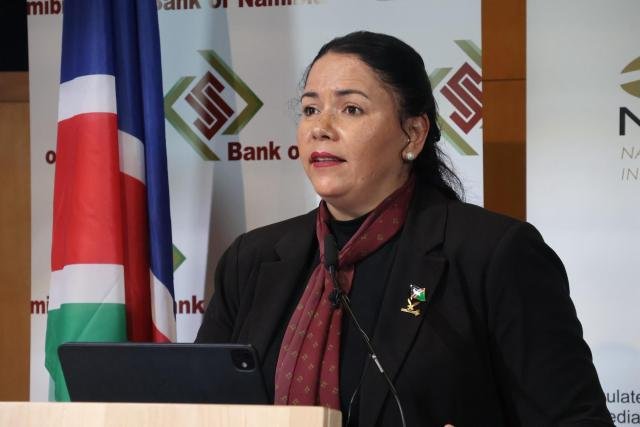
“Cybersecurity Is No Longer Merely An Information Technology Concern,” Says Shafudah
Minister of Finance has called for stronger cybersecurity measures, institutional accountability and cooperation to protect consumers as Namibia expands its digital financial services.

Cybersecurity is no longer merely an information technology concern and has become a national development and economic resilience priority, Minister of Finance, Erica Shafuda said while calling for stronger cybersecurity measures, institutional accountability and cooperation to protect Namibia’s growing digital financial sector.
Delivering the keynote address on behalf of the Minister of Finance at the Namibia Fraud & Cybersecurity Summit on Tuesday, Deputy Director of Information Technology, Stavros Beukes said Namibia’s digital transformation must translate into tangible economic opportunities for individuals and businesses.
He emphasised that building and maintaining trust in digital ecosystems is central to achieving this ambition, particularly as the country expands its digital financial services.
Beukes highlighted Namibia’s Sixth Development Plan, saying that it places economic growth, inclusiveness and resilience at the centre of the country’s development agenda, adding that the Namibian Financial Sector Transformation Strategy 2025–2035, supports these priorities through digital transformation and innovation, financial access, literacy and consumer protection.
Beukes warned that cyberattacks, data breaches and service disruptions have the potential to interrupt essential services, compromise sensitive information and undermine economic activity.
“Cybersecurity is therefore no longer merely an information technology concern. It is a national development and economic resilience imperative,” he said.
He stressed that delivering on Namibia’s digital ambitions requires sustained investment in skills, robust institutional controls, clear accountability and effective incident response mechanisms.
He called for closer cooperation between government, regulators, telecommunications operators and the private sector to strengthen the country's response to cyber threats, saying that Namibia’s financial inclusion rate has reached approximately 86% in 2025.
However, he cautioned that access to financial services alone is not sufficient, with individuals and businesses needing to use digital financial products to transact, save and participate securely in the economy.
Morever, he emphasized that financial inclusion efforts must focus on meaningful usage rather than access alone, warning that fraud threatens to reverse the gains made in expanding financial services.
“For an ordinary household to fraudulently transact could mean the loss of its entire monthly income or life savings. For small businesses, it could mean the loss of working capital and ultimately its ability to remain operational,” he said.
The address also highlighted Namibia’s Instant Payment Programme and the introduction of the Instant Payment System (IPS) as important milestones in modernising the country's national payment infrastructure.
Government-to-person payments processed through the system has increased from approximately 1 million in July 2026 to 10 million in August, 25 million in September and 26 million in October.
Beukes noted that the growth demonstrates the expanding use of the infrastructure and its potential to support wider merchant payments and person-to-person transactions.
He stressed that security and consumer protection must be incorporated into financial products and services from the design stage.
“Security and consumer protection must be embedded in the design of financial products and services rather than introduced as an afterthought,” he said.
Beukes called for stronger financial literacy programmes to help consumers identify scams, protect personal information, verify payment instructions and report suspicious activity.