AGRICULTURE | FMD OUTBREAK
B2Gold Contributes N$1.6 Million Towards FMD Response
The contribution comes as livestock movement restrictions continue to affect farmers' cash flow, while veterinary authorities intensify vaccination and surveillance efforts to contain the outbreak.
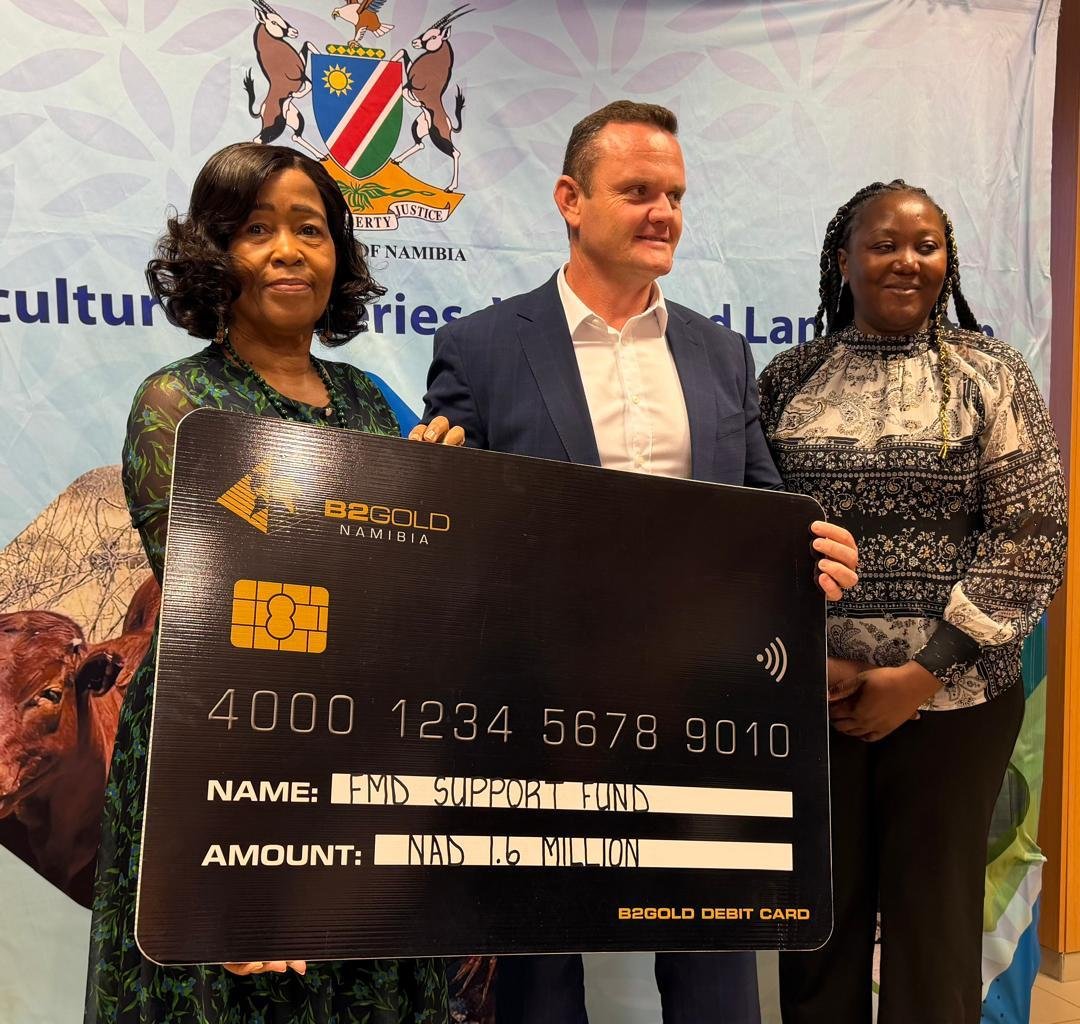
B2Gold Namibia has contributed N$1.6 million towards Namibia’s Foot-and-Mouth Disease (FMD) Support Fund as the outbreak continues to restrict livestock movement and affect farmers' livelihoods across the country.
The contribution was handed over on Wednesday, to the Minister of Agriculture, Fisheries, Water and Land Reform, Inge Zaamwani.
In her acceptance speech, Zaamwani said the funds would primarily support the procurement of critical materials and equipment required by frontline responders working to contain the outbreak.
She further said the goverment, through the ministry and other stakeholders, has intensified biosecurity measures, surveillance, movement controls, veterinary checkpoints and vaccination programmes following the outbreaks in the Karasburg State Veterinary District in the ||Kharas Region and Kalala Island in the Zambezi Region.
She highlighted that these interventions are essential to protecting animal health, preserving livelihoods, safeguarding food security and maintaining confidence in Namibia's livestock value chain.
The minster futher described B2Gold's contribution as an example of corporate citizenship, noting that the private sector had a role to play alongside Government and the farming community in protecting the livestock subsector.
She thanked the mining company for its contribution, saying it demonstrated the private sector's commitment to supporting Government and farmers in protecting one of Namibia's valuable economic subsectors.
Meanwhile, B2Gold's Managing Director (MD), John Roos said the outbreak was not only an animal health crisis but also a livelihood crisis, considering the number of people dependent on the country's agricultural and fisheries industries.
He estimated that approximately 88,000 people were employed in Namibia's fisheries and farming industries, with 71,000 directly involved in crop and animal production.
"So this is not only an animal crisis, this is a livelihood crisis," Roos said.
Drawing on his engagement with farming communities, Roos highlighted the financial difficulties facing farmers who are unable to move their livestock because of the restrictions.
"Farmers sit without cash flow, they're not able to move their animals," he said.
He added that the impact extended beyond the ||Kharas Region to other parts of Namibia.
Roos also pointed to the challenges facing Meatco and Savannah, which he said had been unable to export to the European Union (EU).
Explaining B2Gold's decision to support the fund, he said the company recognised the need for businesses to contribute towards addressing the crisis.
"We're not giving hundreds of millions in Namibian dollars yet to solve the whole crisis. But we want to be part of the solution," he said.
Roos further emphasised the importance of partnerships and transparency in managing the fund, saying corporate contributors needed confidence that their donations would be used responsibly.
"Very often these funds are established, corporates donate money into the fund, and we don't see where the money goes," he said.
He added that reviewing the fund's governance structures, boards and supporting documentation had given B2Gold confidence that its contribution would reach the intended cause.
In addition , Chief Veterinary Officer, Kenneth Shoombe reported that the outbreak remained confined to 18 holdings within the Karasburg State Veterinary District, with the number of positive cases remaining at 131.
Shoombe said veterinary checkpoints and roadblocks had been established at critical areas across Namibia to control the movement of potentially infected animal products.
He explained that such products were not permitted to move from farms to urban areas under the current restrictions, although consumption at farm level had been permitted through veterinary public notification.
"This will allow us to continue ensuring that the disease is contained in one area," he said.
He added that veterinary public notifications would be issued as surveillance data accumulated, allowing authorities to consider relaxing restrictions on the movement of animals and animal products.
On vaccination progress, Shoombe reported that 56,000 animals had been vaccinated on Kalala Island, while more than 8,000 had been vaccinated in the Karas area, out of an expected total of more than 13,000 animals.
He said the first round of vaccination had been completed, with veterinary authorities waiting for the 28-day period to pass before initiating the second round.
Shoombe explained that the second round would help strengthen antibody production among vaccinated animals, reduce infection rates and limit the shedding of the disease among susceptible animals.
He further reported that surveillance conducted up to Wednesday, had not detected any cases.
"Since we have started the surveillance, we have not picked up any case outside of the epicenter. This is good news and I encourage all of us to continue adhering to this," he said.
Moreover, Zaamwani said Government remained committed to working alongside farmers, traders and affected communities to ease the burden caused by movement restrictions, stressing that the easing of restrictions would depend on continued adherence to disease control measures and progress in containing the outbreak, while emphasising the need to facilitate the resumption of livestock trading under prescribed conditions.
"Our interventions must equally be geared towards easing restrictions in order to facilitate resumption of trading under prescribed conditions in order to protect livelihoods, preserve market confidence, and securing the future of our agricultural economy," she said.