Home Market & Sectors Agriculture & Oceans
MANUFACTURING
Namibia Dairies Upgrades Processing As Dairy Farmers Face Rising Costs
The new processing technology is expected to improve production efficiency and accommodate potentially higher milk volumes, but expensive animal feed, drought risks and livestock movement restrictions continue to weigh on local dairy producers.
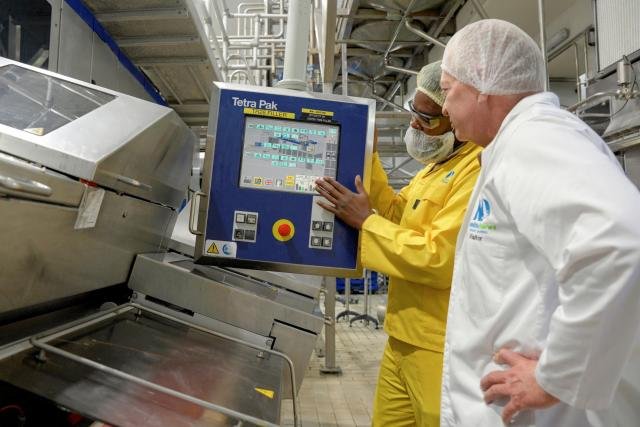
Namibia Dairies is upgrading its milk processing operations to improve production efficiency and strengthen local manufacturing, as dairy farmers continue to face rising input costs and challenges to expanding domestic milk production.
OL Group Executive Chairman, Sven Thieme said the investment in a new Tetra Pak A3 Flex filling line reflects the group's confidence in local manufacturing and its commitment to maintaining modern production standards.
According to a media statement issued by Namibia Dairies, the new filling line replaces a machine that had been in operation for more than 15 years and can process up to 8,000 packs per hour.
The upgrade includes a new conveyor system, helix accumulator, cardboard packer, advanced cap application technology and supporting packaging equipment.
"Investments of this scale reflect our confidence in our people, our products and the future of Namibian manufacturing. They demonstrate our commitment to maintaining world-class production standards, supporting local food production and ensuring Namibia Dairies remains a modern, competitive manufacturer for years to come," Thieme said.
The improved processing capacity is expected to strengthen the company's ability to handle potentially increasing milk volumes, including supplies from local dairy farmers.
Speaking to Business Pulse360°, Namibia Dairies representative Carmen Maartens said the company supports local dairy farmers through milk offtake, processing capabilities and access to markets, where commercially and operationally viable for both parties.
"From our perspective, increased viable local production can only benefit Namibia. It supports greater local value creation, helps retain economic activity and employment within the country and reduces the distance between local primary production, processing and the consumer," Maartens said.
However, she cautioned that improved processing capacity does not automatically translate into increased demand for locally produced milk, saying sustainable growth depends on the competitiveness of the entire dairy value chain.
The Namibia Agricultural Union (NAU) said more efficient processing operations could allow farmers to supply larger milk volumes because improved production lines can package milk at a faster rate.
However, the union said the possibility of dairy farmers expanding their herds remains uncertain amid the country's drought outlook and current foot-and-mouth disease (FMD) restrictions on the movement of live animals.
Increasing dairy cattle numbers could help raise milk supply, but the prevailing conditions may influence farmers' willingness and ability to invest in expanding their herds.
The NAU identified high production costs, particularly animal feed, as one of the biggest challenges facing local dairy farmers.
Dairy farming is capital- and input-intensive, requiring substantial quantities of feed, which has become increasingly expensive to procure.
According to the union, rising production costs have made it difficult for some dairy producers to break even, resulting in several farmers leaving the industry.
The union also warned that the limited number of milk processors creates transportation challenges for farmers who must deliver their milk to processing facilities, adding to the cost of production.
Maartens said Namibia's relatively small domestic market, long transport distances and climatic conditions make it difficult for local producers to compete with larger international dairy markets that benefit from economies of scale.
"The fundamental challenges facing local dairy production have remained largely unchanged over many years," she said.
She added that efficient local processing could provide farmers with a potential route to market closer to home, provided milk volumes, quality requirements and commercial conditions are mutually viable.
Beyond processing efficiency, the new filling line is expected to reduce packaging waste from approximately 4% to 1.5%.
Redesigned packaging configurations and materials sourced from South Africa are also expected to reduce stockholding requirements and improve supply chain efficiency.
The technology uses ultra-high temperature processing, allowing unopened long-life milk to remain shelf-stable for six to nine months without refrigeration.
Namibia Dairies said the investment could also create opportunities for future product development, including 500ml long-life milk formats and possible expansion into ambient juice products.
Maartens said strengthening the local dairy value chain would require viable farmers, competitive processing operations and sustained consumer demand.
"Primary production and local manufacturing therefore need to strengthen together if Namibia is to retain more value and employment within the country," she said.