Home Market & Sectors Mining & Minerals
MINING AND CRITICAL MINERALS
Aldoro's Seawater Leaching Results Confirmed By Second Independent Lab
Independent laboratory tests in South Africa have reproduced the company's earlier seawater leaching results, providing further support for processing studies at its Kameelburg rare earth project in Namibia.
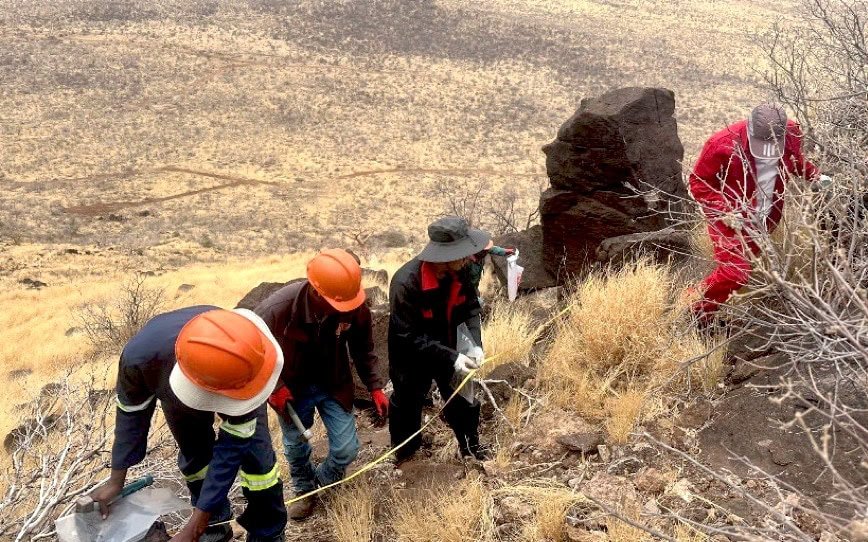
Aldoro Resources has announced that a second independent laboratory has reproduced its seawater leaching results on samples from the Kameelburg Rare Earth, Niobium and Strontium Project in Namibia.
In an Australian Stock Exchange(ASX) report released on Monday, the company said CM Solutions(CMS) in Johannesburg, South Africa, reproduced earlier findings from ALS Metallurgy in Perth, Australia.
The new tests used a composite sample from nine mineralised drill-holes, widening the earlier work, which relied on a single drill-hole. Total rare earth mass-balance closure reached 98.1%.
Sea leaching generally refers to the dissolution and transport of minerals, salts, metals or pollutants into or out of solids through seawater and marine water movement.
Under the seawater process, primary-stage hydrochloric acid consumption was 300 kg per tonne of concentrate, compared with 430 kilograms in the freshwater control test.
At that dosage, the seawater test extracted 58.9% of total rare earths and 90.6% of strontium. A follow-up acid treatment lifted cumulative rare earth extraction to 66.2%, bringing total acid use to 384 kg per tonne.
The lower dosage also cut impurities in the processing solution. Barium co-dissolution fell to 4.7% from 69.1% in the freshwater test, a 93% reduction.
Aluminium in the primary seawater filtrate measured 75.4 mg per litre, against 213 mg per litre for freshwater. Aldoro said fewer impurities could reduce the need for extra purification stages when producing Mixed Rare Earth Carbonate(MREC) and Strontium Carbonate (SrCO3).
Aldoro Resources Executive Chairperson, Quinn Li said consistent results from two laboratories, across samples from nine drill-holes, give the company a technical basis for its scoping study, pilot plant and pre-feasibility study.
She added that lower acid consumption and fewer impurities could cut reagent costs and reduce the capital needed for acid storage.
The company tied the findings to its proposed development model, with mineral processing at the mine site and a separate coastal refinery near the Port of Walvis Bay.
Using seawater at the coastal plant, it said, could lessen reliance on inland freshwater and the infrastructure needed to move and store it.
Aldoro estimates the method could deliver MREC purity above 90%, possibly reaching about 95%, and strontium carbonate purity of 85% to 90%.
These figures are based on solution chemistry and laboratory data; physical testing to confirm actual product purity is still underway. CMS is continuing direct MREC precipitation tests, followed by processing to recover strontium carbonate.
The results will help establish product grades and supply samples for further testing. The updated findings are being fed into the Kameelburg Scoping Study and preparations for the Mining Licence.