Home Market & Sectors Tech & Innovation
ENERGY
Namibia’s Green Energy Investments Must Deliver Economic Benefits for Local Communities
The Institute for Public Policy Research says Namibia's energy transition must go beyond attracting investment and generating exports to ensure communities benefit through employment, skills development, local businesses and revenue-sharing arrangements.
Communities living near Namibia’s emerging green hydrogen and renewable energy projects must have a direct stake in the economic opportunities created by these developments, the Institute for Public Policy Research (IPPR) has said.
The institute has called for stronger community participation in energy investments, including access to jobs, business opportunities, skills development and revenue-sharing arrangements, arguing that the country’s energy transition should deliver lasting benefits beyond investment and export earnings.
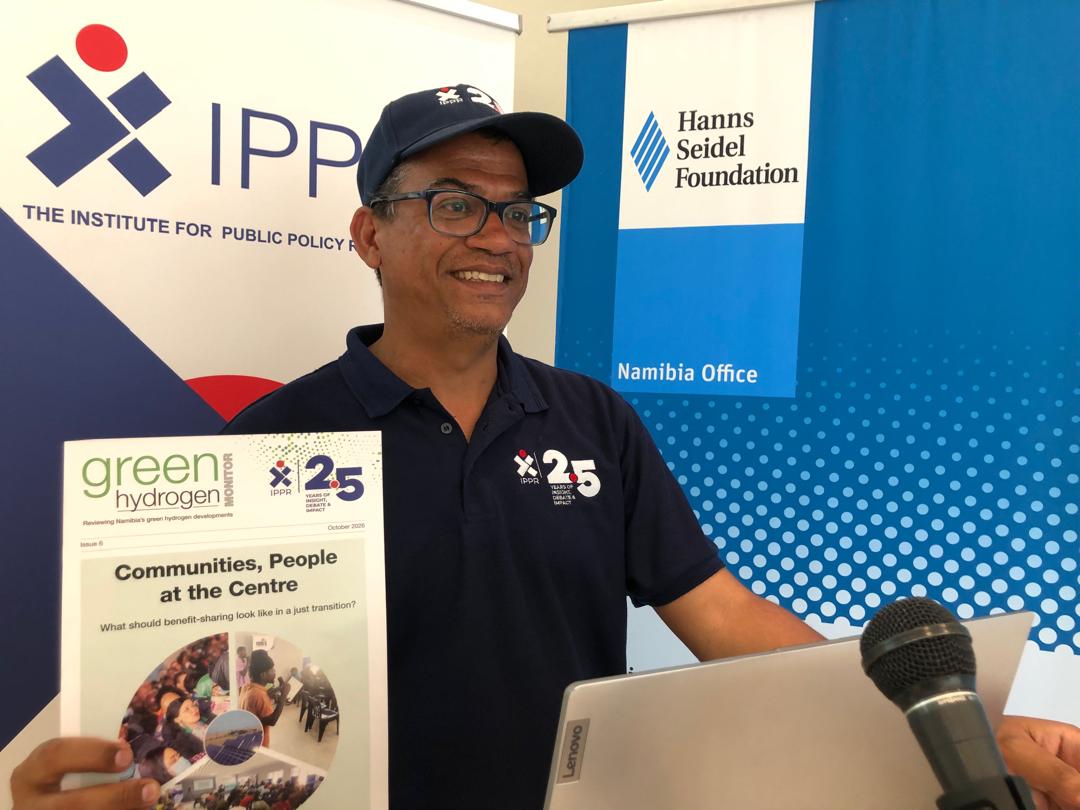
IPPR Executive Director Graham Hopwood, made the remarks during the launch of the sixth edition of the Green Hydrogen Monitor in Windhoek on Friday. He said the country's energy transition should be measured not only by investment commitments and export potential but also by improvements in the lives of communities closest to development projects.
"A successful energy transition cannot be measured simply by the number of projects announced, the billions of dollars in projected investment or the volume of hydrogen exported," Hopwood said.
He said communities should benefit through employment, skills development, business opportunities and infrastructure, while also having access to land and water protected and their existing livelihoods safeguarded.
Hopwood stressed that community benefit-sharing should extend beyond corporate social responsibility initiatives, such as donations to schools, sports teams and local charities.
"A few donations to schools, sports teams or local charities may be welcome, but they are not a substitute for fair and lasting economic participation," he said.
He identified community equity stakes, revenue-sharing arrangements, local procurement, community trusts and enforceable employment and training commitments as possible mechanisms to ensure communities participate in the economic value generated by energy projects.
IPPR Researcher, Frederico Links, said the institute's engagements across Namibia had revealed that many people, particularly young people, felt they were not receiving sufficient information about opportunities linked to the country's emerging energy sector.
He said young people in villages and towns outside major centres wanted to understand what developments in their areas meant for them and how they could participate in the opportunities being created.
Links said communities had repeatedly expressed their desire to benefit both individually and collectively from the country's energy ambitions.
"People have repeatedly said in the engagements that we've had across the country that they want to benefit," he said.
He added that inadequate communication had created information gaps, leaving communities uncertain about the opportunities available to them.
Links also argued that community benefit-sharing should be treated as a human rights issue rather than simply an optional corporate social responsibility initiative.
"Fundamentally, this is a human rights issue," he said.
Beyond economic participation, Hopwood called for stronger environmental oversight to ensure Namibia's regulatory framework can manage the risks associated with large-scale developments, including green hydrogen, renewable energy, critical minerals and offshore oil and gas.
He called for greater transparency in environmental assessments, stronger public participation and more effective monitoring of environmental commitments after projects receive approval.
Hopwood also called for a review of the Environmental Management Act and the environmental impact assessment system to make them more transparent, participatory and effective.
He said credible environmental regulation should not be viewed as an obstacle to investment, as it could provide greater certainty for investors while protecting communities and ecosystems.
Meanwhile, IPPR announced that the publication will be renamed the Green Energy Monitor from next year, with two editions continuing to be published annually.
Hopwood said the expanded publication would cover a broader range of issues affecting Namibia's energy transition, including renewable electricity generation, energy security, electricity affordability, transmission infrastructure, critical minerals and industrial development.
He emphasised that the change did not mean IPPR was abandoning its focus on green hydrogen, which remains an important potential opportunity for Namibia.