Home Market & Sectors Tech & Innovation
Germany’s N$822 Million Namibia Package Awaits Measurable Economic Targets
Namibia and Germany are reshaping their longstanding development partnership around green growth, climate resilience
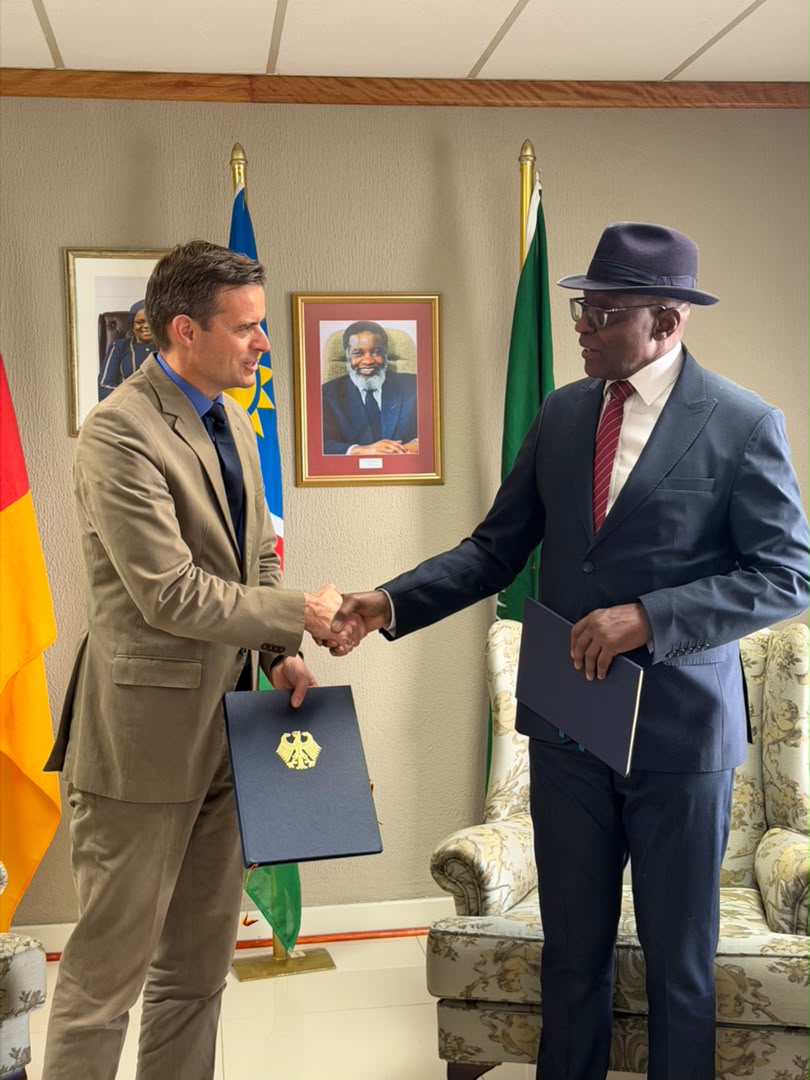
Namibia and Germany are yet to agree on measurable employment, skills development and investment targets under their evolving development partnership, despite €43.8 million (about N$822 million) committed during bilateral government negotiations in 2025.
The funding forms part of a broader cooperation programme that the two countries are reshaping around climate resilience, green energy, skills development and economic transformation.
Responding to questions from Business Pulse 360, the German Embassy said most projects agreed upon in 2025 remain under preparation or have only recently entered implementation, meaning the full economic impact of the commitments is yet to be established.
The Embassy also confirmed that specific initiatives under the partnership’s latest strategic priorities remain under discussion, with new funding commitments expected during government negotiations in 2027.
The direction of the partnership emerged from the Namibia-Germany Strategic Dialogue held in Opuwo late last month, where the two governments identified climate-resilient water security, biodiversity and livelihoods, alongside a just green energy and skills transformation, as key priorities.
Germany has provided more than €1.6 billion, equivalent to approximately N$30 billion, in official development assistance to Namibia since independence in 1990, according to the two governments.
Germany describes Namibia as the largest recipient of its development cooperation in Africa on a per-capita basis.
The cooperation has supported renewable energy, water security, biodiversity conservation, sustainable urban development, vocational training and private-sector development.
The latest priorities seek to link these interventions more directly to economic diversification, employment creation and the development of green industries.
Of the N$822 million committed in 2025, approximately N$446 million (€23.8 million) is in grants, while about N$375 million is provided through a concessional loan.
The largest allocation is a €20 million (approximately N$375 million) loan from KfW Development Bank for the Sustainable and Inclusive Electrification Namibia programme.
Other allocations include about N$64 million for technical and vocational education and training through the German development agency GIZ, N$56 million for improving energy access and N$47 million for inclusive and sustainable urban development.
A further €2.5 million (approximately N$47 million) grant, implemented by the Federal Institute for Geosciences and Natural Resources (BGR), supports critical raw materials for the energy transition.
Natural-resource and conservation initiatives include €3 million (approximately N$56 million) for climate-resilient agriculture and food security, €4.2 million (approximately N$79 million) for sustainable financing of protected areas and another €4.2 million (approximately N$79 million) for community conservation.
An additional €1 million (approximately N$19 million) grant supports a GIZ Study and Experts Fund.
The projects are implemented through GIZ, KfW and BGR and form part of a wider portfolio comprising more than 50 projects.
However, the Embassy cautioned that funding commitments typically cover projects spanning several years and should not be interpreted as money already disbursed or spent.